
Our Mission: The Mattabeseck Audubon Society, a chapter of the National Audubon
Society, is committed to environmental leadership and education for
the benefit of the community and the earth's biodiversity.
deKoven House,
27 Washington Street,
Middletown, Connecticut 06457
Helen Carlson Wildlife Sanctuary
. . . a nature preserve consisting of a variety of habitats, including an ever-changing wetland that was once a unique cranberry bog.
Open free to the public all year round.
The Helen Carlson Sanctuary has now been designated an eBird Hotspot:
Helen Carlson Wildlife Sanctuary, Middlesex, Connecticut, United States - eBird Hotspot
LINK TO SANCTUARY SPECIES ID LIST PAGE
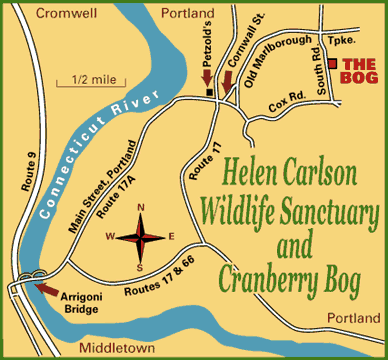
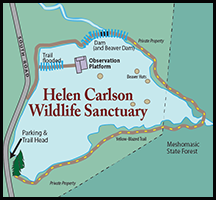
Owned by and maintained by volunteers from the Mattabeseck Audubon Society.
Please visit our 19-acre Carlson Sanctuary to observe the natural diversity of this unique site.
Contributions toward the maintenance of the Helen Carlson Wildlife Sancutary can be made to the Mattabeseck Audubon Society Sanctuary Fund, deKoven House, 27 Washington Street, Middletown, CT 06457.
History
The slow-moving stream that feeds the area of the sanctuary provided moisture for the development of many wetland plants. A study of the geology and paleoecology of the site by Wesleyan student Brian Betensky determined that cranberries (Vaccinium macrocarpon) have been growing here for at least 3,000 years. Early English colonists noticed the succulent fruits and harvested the wild berries. By the nineteenth century, the same 13 acres of this wetland changed hands often as the site was developed for market production.
Unlike the flooded commercial cranberry sites at Cape Cod, MA, the cranberries here were dry harvested, using a wooden box with metal tines acting like fingers that combed through the plants to collect the berries for sale.
In the 20th century, new plots were created by laying sand and moving plants from the original wild area of the marsh. Ditches were excavated to funnel water into and out of the plots. This complex water control system flooded the cranberry plants in the winter to protect them from freezing and drained the water during the growing season.
Preservation
By the 1950s, the cranberry operation on South Road had declined and few berries went to market. Fearing that the bog would be sold and mined for peat, Portland resident Helen Carlson, well-known for her interest in the environment, purchased the cranberry bog. Mrs. Carlson donated the site to the Mattabeseck Audubon Society (MAS) in 1976 to preserve it forever. Shortly thereafter, with a grant from the Rockfall Foundation in Middletown, MAS worked with students from Long Lane School to create a nature trail and boardwalk through the wetland and adjacent forest. In 1978, the trail was opened to the public, and the site was dedicated to Mrs. Carlson.
Evolution
For about 20 years, MAS maintained the nature trail and boardwalk and followed a plan to nurture the cranberry plots in much the same way as was done during the days of commercial production. This included regular flooding and draining, mowing, and periodic sanding to rejuvenate plant production.
A family of beavers moved into the sanctuary about the year 2000, raising the water level and completely changing the ecosystem. The continuous high water caused by the many dams constructed by the new residents virtually wiped out the cranberries and other acid-loving plants that colonized the site. The boardwalk rotted and had to be discontinued, and other parts of the trail became impassable. The site is now an open water marsh with emergent water plants.
Viewing Platform
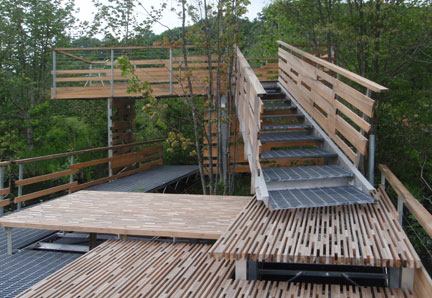
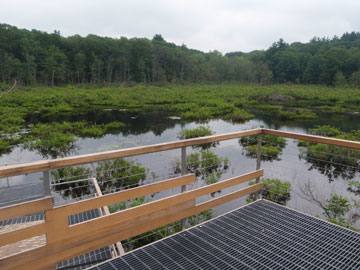
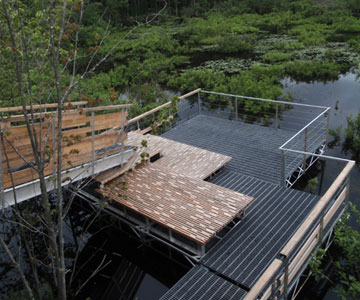
While struggling to find a way to provide an optimal experience at our sanctuary, MAS was contacted by Wesleyan University Assistant Professor of Art Elijah Huge in the fall of 2007 with a proposal to build an observation station. Over the spring semester of 2008, his Architecture Research-Design-Build Studio class designed, planned, selected and acquired materials, and constructed a split-frame elevated viewing station consisting of a lower floating observation deck and an elevated platform connected by a hinged staircase that moves and corrects for changing water elevation. The lower deck includes a multi-tiered seating arrangement for visitors and students. The upper platform is supported by an aluminum frame with cypress railings and recycled plastic flooring, overlooking the sanctuary and beaver lodge. This state-of-the art observation platform offered easy access to viewing. Because it floats on the changing water level it is sustainable and maintenance free, and has served as a prototype for other organizations interested in similar projects.
Beavers
The beaver (Casteroides canadensis) was extirpated from Connecticut by the early 1800s as a result of the fur trade. In the early 20th century, the beaver was reintroduced to the state. Since then, they have proliferated and occupy most wetland areas. Beavers are the largest rodent in North America, are magnificent engineers, and are second only to humans in the creation of habitat. Beavers at the sanctuary have been known to stop the flow of water in 15 minutes.
The beaver is uniquely adapted to its watery domain. Besides its thick skin and dense fur that insulate its body, it has webbed feet for swimming, and its lips seal around its mouth to keep water out while internal valves automatically close the ears and nose. Its eyes have a special nictitating membrane that allows it to see under water. It uses its tail as a rudder for swimming and as a warning device by slapping the water to alert other beavers to danger. Its large front teeth grow continuously so that it can cut down trees for dams, lodges, and food.
When first arriving in an area, they build a dam to hold back the water to a sufficient depth to build a lodge of sticks, logs, and mud. Then, they chew into the lodge making several entrances and living space. The water level must be maintained so that the entrance is far enough under water to keep from being frozen in winter. Otherwise, they can’t go in and out to feed. Branches of food are stored under water near the lodge. While beavers have preferences for food, they will eat almost any type of vegetation.
Baby beavers, kits, are born in the spring. Young beavers stay with their parents until their second year when they are forced to leave home to mate and start another colony.
What to See
In June along the path to the viewing platform, two species of orchid bloom— Rose Pogonia and Calopogan. Sundews, carnivorous plants that catch their prey in sticky, spatula-like leaves, may be seen along the damp trenches. In the deeper water, you may see Wood ducks, Painted turtles, Canada geese, and herons.
At dusk, the beavers leave their lodge for an evening of work, cutting trees and shrubs to maintain their food supply and shore up any leaks in their dams. The beaver lodge can be seen from the viewing platform to the east side of the lake.
Along parts of the old trail system to the north and south, you may see White-tailed deer, large expanses of ferns, beaked hazelnuts—a shrub with an acorn-like fruit concealed by extended tubular bracts that look like a long snout—and witch hazel, which produces a wispy, yellow flower around Halloween. Deeper into the forest, you may hear the flutelike song of the Wood thrush.
New aquatic vegetation has replaced the cranberries. Water-shield, with its oval leaves, and white Fragrant water lilies now cover the surface of the water. The sweet-smelling shrub Buttonbush, a favorite of butterflies, has become prevalent. It gets its name from the round clusters of small flowers that resemble pin cushions. After flowering, the heads turn into ball-shaped “buttons.” Also new is Meadow beauty, a deep pink flower with unusual curving yellow stamens.
Submerged portions of all aquatic plants provide habitats for many micro and macro invertebrates. These invertebrates in turn are used as food by fish and other wildlife species, especially frogs that can be heard singing in the spring and croaking through the summer.
Link to Archival Bog Information from past Wingbeats
Helen Carlson Sanctuary Clean-up Day
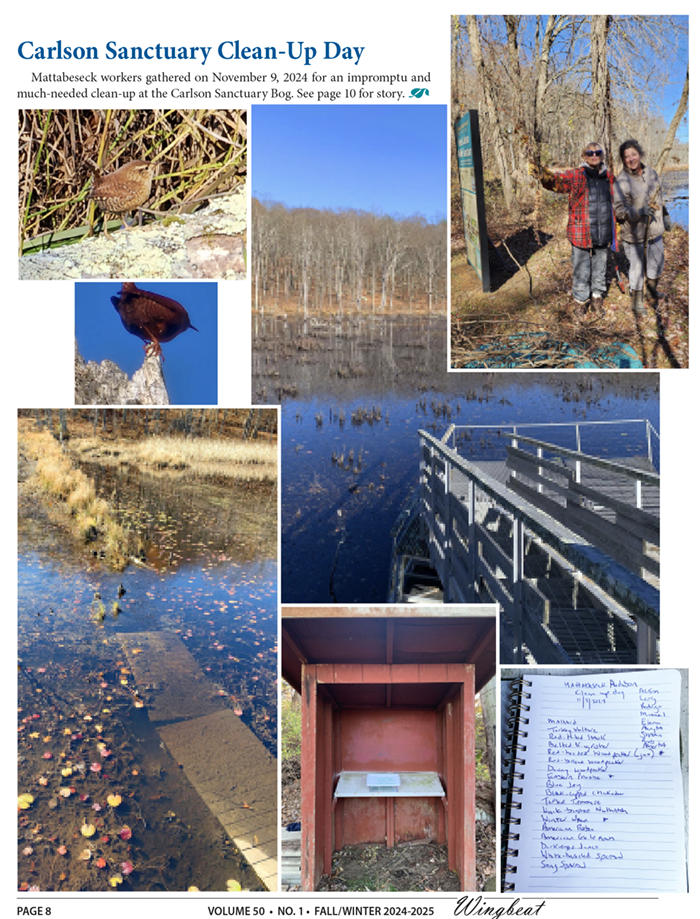
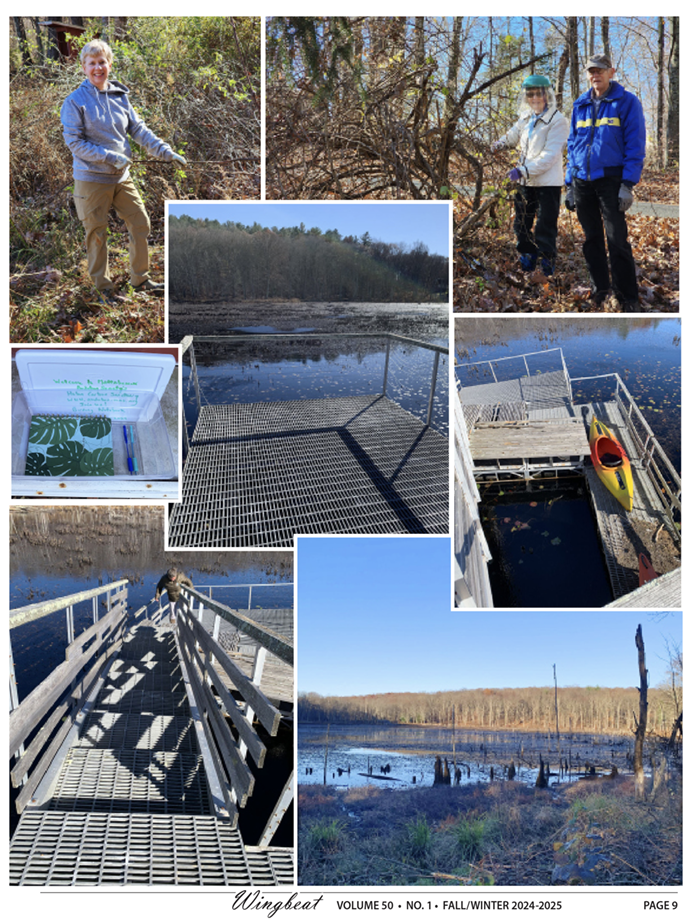
On Saturday, November 9th a group of Mattabeseck Audubon Society board members (and former board members) met at the sanctuary to perform some necessary clean up. The board members included: Alison Guinness, Elena Coffey (mastermind of the clean-up day), Larry Cyrulik, Sharon Dellinger, Michael Good, Rodrigo Pinto, Annyta Vizard, with past board members Rob and Alberta Mirer joining in.
Annyta, Elena, Rob & Alberta were able to clear out a lot of invasive vines at the entrance near our billboard, which greatly improved views of the marsh. Alberta helped us to identify the plants to ensure nothing important was removed. Sharon and Alison cleared out the dumping area which has been an eyesore at the beginning of the trail. Larry, Michael, and Rodrigo used a chainsaw to cut trees that had been blocking the trail.
We also realized that hikers were still using our hut and deteriorating notebook to let us know when they visited and what birds they saw. Sharon returned to the sanctuary to place a new notebook and pens, protected in a plastic tub, for future birders and hikers to leave their comments.
Lend-a-Paw Day at the Sanctuary
 |
 |
||
 |
|||
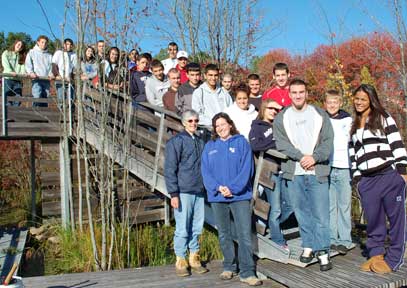
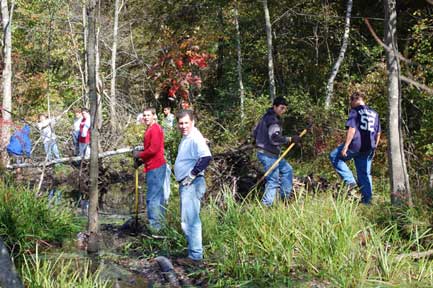
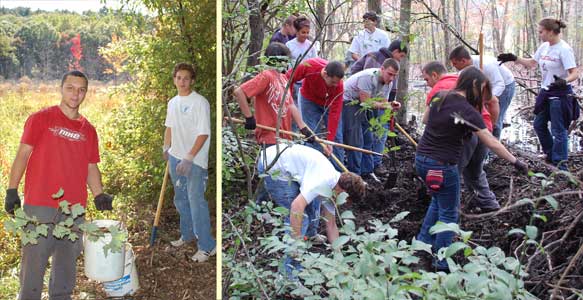
For the 3rd time, students from Rocky Hill High School came to the Carlson Sanctuary to help with maintenance as part of their community service program called Lend-a-Paw. Twenty-two students, led by their teacher and MAS board member, Kim Antol, spread wood chips along the trails, repaired vandalism to the viewing platform, cleared the trail of downed trees, removed fallen branches in the parking area, and took out 5 beaver dams to increase the flow of water through the sanctuary. When asked what their favorite activity was, they always say, “Dam busting.” Mattabeseck is grateful for their help, without which, many of these tasks would not get done.
|
|
||
|
|||
Thank You from MAS from Joanne Luppi
Mattabeseck Audubon Society is very grateful to Ben Srb and his employees of Primary Landscaping in Portland. Ben was able to haul the corn crib from the 400 William St. property to the Portland Historical Society’s Museum property on Main St. in Portland. This is one of the few corn cribs remaining in Portland and Mattabeseck donated it the Historical Society because of its historical significance. We also appreciated Ben’s removing an old car from the rear of the property for us.
Primary Landscaping has been more than helpful to Mattabeseck. Both this fall and last fall they have delivered a load of wood chips to the Helen Carlson Sanctuary. These chips were used by the Rocky Hill High School students to mulch the trail to the new observation platform. The students were amazing as they worked at the Sanctuary for their “Lend-a-Paw” day. Spreading of the chips was only one of the many tasks they completed.
Viewing Platform Dedicated to Vince Marteka on October 19, 2008

It all began with a mid-winter presentation by Elijah Huge, Wesleyan University architecture professor, to the MAS Board of Directors. Would the Board be interested in an observation station placed strategically for greatest effect within the MAS-owned Helen Carlson Sanctuary in Portland? Professor Huge’s students would be responsible for visiting the site, developing an appropriate design, and building the final product.
It seemed like a winning combination—MAS’s need for a new observation platform, and an opportunity for Professor Huge to give his students a hands-on project to further their understanding of real-world architectural concerns.
The Board gave their unanimous approval. A series of visits to the Helen Carlson Sanctuary by Professor Huge and several students, accompanied by MAS President Alison Guinness, led to several designs that were eventually pared down to the winning idea.
The platform had to be made of durable, maintenance-free material. It had to be innovative and stylish while still functional. It had to come within budget. And it had to overcome the main physical constraint of the Sanctuary—water. Beaver dams have raised the depth of the water and made any engineering other than the beaver’s own work very challenging.
At the end of April, Professor Huge and his students undertook the challenge. They labored enthusiastically throughout the month of May, aided by MAS volunteers who broke the beaver dams every day for a week, in order to lower the water level enough to allow footings to be sunk for the upper level of the observation platform.
By June, the platform—consisting of aluminum frames with cypress railings and seating, and recycled plastic flooring—had essentially been installed. There is some minor detailing to be completed, but the platform is functional and open to the public. MAS hopes everyone will enjoy the view, and the workmanship.
Our thanks once again to Professor Huge and the Wesleyan students!

For winter skating conditions
call John LeShane 860-342-0658.
Please note: Properties owned by Mattabeseck Audubon Society are not open for the removal of ANY plant or animal species, alive or dead, without consent of the Board of Directors.