Our Mission: The Mattabeseck Audubon Society, a chapter of the National Audubon
Society, is committed to environmental leadership and education for
the benefit of the community and the earth's biodiversity.
deKoven House,
27 Washington Street,
Middletown, Connecticut 06457
Visit Mattabeseck Audubon on Facebook
MAS Annual Meeting
Our annual meeting will be held on Wednesday, May 21 at 7 p.m. at the deKoven House.
Proposed changes to MAS bylaws will be on the docket for this meeting. A copy of our Bylaws with proposed changes is inlcuded in MAS Spring-Summer Wingbeat (link below).
Wild Bird Mortality Reporting Survey
Wild birds are susceptible to several diseases, such as avian influenza, aspergillosis, salmonellosis, West Nile virus, and avian pox, that can cause widespread mortality events. Highly pathogenic avian influenza (HPAI) is one of the leading causes of large mortality events in wild birds. Current scientific evidence indicates that outbreaks of HPAI usually involve the death of a large number of waterfowl or shorebirds – as opposed to individual birds people may find on their property. As a result, when it comes to surveillance of dead wild birds as an early detection measure, DEEP will primarily focus on events that involve large numbers of birds. At this time, we will not routinely be testing individual birds that are found dead, especially if they are backyard birds such as robins, pigeons, cardinals, etc., as they are not considered to be highly susceptible to HPAI.
CT DEEP is, however, interested in all mortality events and will follow up on those that biologists feel are indicative of a potential HPAI or other wildlife disease outbreak.
Please help us monitor wild bird populations in Connecticut.
• If you see several dead birds (>5) in one location or notice that several birds die in the same area over the course of several days, this is a situation where testing of the dead birds may be warranted. If you observe this type of die-off, in addition to filling out this form, please call the DEEP Wildlife Division at 860-424-3011.
• Individual wild backyard birds that are found dead can be reported here and should be disposed of properly (bury or double bag and place in your garbage receptacle).
• Sick or dead domestic birds – mainly poultry - should be reported to the Connecticut Department of Agriculture, State Veterinarian at 860-713-2505. Learn more about Avian Influenza, West Nile Virus, and other Bird Diseases.
Link to report, with fill-in-blanks form and map:
https://survey123.arcgis.com/share/b001d37ec7294ca5927aab79f2f2ce2e
Christmas Count 2024 Results and Report
(Click title to go to full report.) Briefly, 42 participants, 11 feeder watchers, 84 species.
Here is a link to the detailed tally.
Invitation to participate in brain health study
Judy Zhu and her team from University of Toronto/Rotman Research Institute are working on neuroplasticity and lifespan learning. Currently doing outreach across Canada, and the US with a short online study, they are examining how birding and citizen science activities contribute to cognitive and brain health.
The study is open to anyone 18+, takes ~15 minutes, and requires no prior birding experience. Participants can choose to enter a raffle for a gift card, or one of several pairs of binoculars from our sponsors.
At the population level, we’re exploring how trends in species prevalence correlate with geographic trends in how people perceive and categorize birds. At the smaller scale, we have a line of neuroimaging research looking at beneficial changes to brain structure and function that result from decades spent learning about birds. More details about the study as well as links to past publications and articles can be found at the study website, www.birdingstudies.com. Audubon Magazine carried an overview of this research:
https://www.audubon.org/magazine/spring-2023/yes-birding-does-change-your-brain
April 19, 2025, 8.am. — Meet at Cromwell Stop & Shop/ Mattress Firm side
Wildflower Walk (Guiffrida Park, Meriden)
MAS is holding a series of Town-by-Town Special Anniversary Field Trips in 2025. Below is the abbreviated list. (Some additional "regular" trips may also be held.) Click the Upcoming Field Trips link above for full descriptions of trips and meeting places.
Download Spring-Summer 2025 Wingbeat
The new issue of Wingbeat is now available for download. This .pdf file can be read on iPad, computer, and most tablets, and may be printed (letter-size pages) in color or grayscale.
To receive an emailed LINK to download each new issue as it is issued, please send your email address to pat_rasch@comcast.net and please put WINGBEAT in the message title. Issues will also be available to download anytime from our home page.
We may also send out special announcements or cancellations via email (only if we have your email address on file!)
Many thanks to George Landis for sending this image.
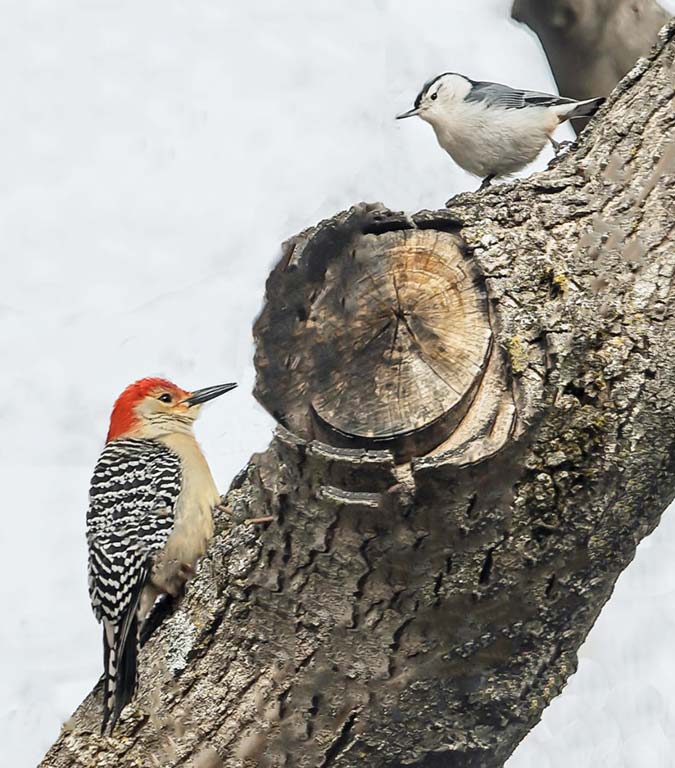
Red-bellied woodpecker and White-breasted nuthatch, Feb. 2025
If you find a baby bird or an injured animal...
If you find a baby bird or other baby animal, it's best to leave it alone.
Chances are the parent is nearby and will take care of the baby when you
leave the area.
If you have some other wildlife problem, contact the
CT Wildlife Rehabilitators Association at http://www.cwrawildlife.org/ where you can find a rehabilitator in your area or someone to address your problem. CT DEEP dispatch phone number: 860-424-3333. CT DEEP list of wildlife rehabilitators bit.ly/2CoDTxu
Wingbeat Deadline for Next Issue
The deadline for items to be included in the Fall/Winter Issue is September 26, 2025. Please send items to Pat Rasch, 24 Elm Road, Cromwell, CT 06416, or email to <mattabeseck@mac.com>. Please add "WINGBEAT" to the message's subject line.
Mattabeseck Audubon Needs Your Help
We need you. There is always a need for new volunteer leaders in any organization, but the past couple of years have brought losses to our board that have created even greater challenges.
We’re always looking for new board members.
Please contact us (phone / e-mail / slow mail) and let us know if you’d like to help.
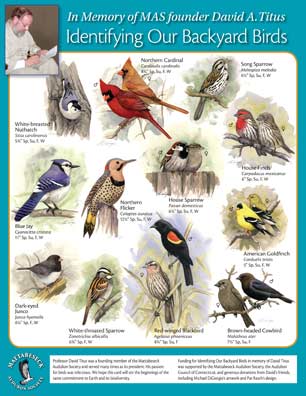 David Titus Memorial
Bird Card—
heavy-duty laminated
plastic—only $3.00!
Our David Titus Memorial Bird Card is available for a $3 donation. Please email your request for bird cards to mattabeseck@mac.com. Bird cards are also available at any Mattabeseck-sponsored programs (but not on field trips).
Many thanks to local wildlife illustrator, Mike DiGiorgio, (www.mdigiorgio.com) for his beautiful illustrations, many of which were painted specifically for this bird card. The card is a very inexpensive way to own some of the best bird art you’ll ever see.
It is extra heavy-duty, all-plastic laminate, printed in full color on both sides. Twenty-four birds are identified by their common name and Latin name, along with the length of the bird and the seasons that they are usually seen in our area. In species that have visual differences between the sexes, both sexes are portrayed.